Gutter Overflowing in Heavy Rain? 4 Fixes That Work
Stop water pouring over your gutters with bigger gutters, extra downpipes, firm brackets and cheap mesh leaf guards you can fit yourself.
Published

A gutter overflowing in heavy rain sends water down your walls, splashes mud onto your doors and soaks the ground right next to your foundation. In many parts of Southeast Asia the late wet season brings the hardest storms of the year. Weak gutters fail in these storms first. The good news is that most overflow problems have four simple causes, and a family can fix most of them with common tools and materials. This guide walks you through each fix in order. Watch your gutters in the next storm, then pick the fixes you need.
Why a gutter overflowing in heavy rain happens
Stand outside under an umbrella during a downpour, away from the roof edge, and watch where the water goes over. Each place tells you something.
- Water pours over the whole length: the gutter is too small for the roof area.
- Water pours over at one end or in the middle of a long run: there are not enough downpipes, or they are too far apart.
- Water pours over at one low spot: a bracket has sagged and the gutter has lost its slope.
- Water backs up near the outlet: leaves, seeds, nests or mud are blocking the gutter or downpipe.
Write down what you see. Many houses have more than one problem. Conditions differ a lot from place to place. Rainfall, roof types, building rules and prices are not the same in Cambodia, Thailand, Vietnam, Laos, the Philippines, Malaysia or Indonesia. For bigger houses, two-storey work or any doubt, ask an experienced local builder before you start.
Safety first before you climb
Gutter work happens at height, and falls from ladders are a common cause of serious injury. Follow these rules every time.
- Only work on a dry, calm day between storms. Never climb in rain, wind or lightning, and never on a wet roof.
- Use a sound ladder on firm, level ground. Tie the top to something solid or use a stand-off, and have a second person hold the base the whole time.
- Keep three points of contact. Carry small tools in a belt or bucket on a rope, not in your hands.
- Wear work gloves (old metal gutters and mesh have sharp edges), sturdy rubber-soled shoes and eye protection when cutting or drilling.
- Look for power lines and roof wiring before you lift a ladder or a long gutter. If wires are close, stop and call the electricity company or an electrician.
- Old grey fibre-cement gutters or roof sheets may contain asbestos. Do not cut, drill or break them. Ask a professional.
- If the fascia board behind the gutter is rotten, or the roof is high or steep, call a carpenter or builder.
Fix 1: Fit bigger gutters where the flow is too much
If water spills over the full length, the gutter cannot carry the water fast enough. Many houses have small 75 to 100 mm PVC gutters. In tropical downpours, a gutter of 125 to 150 mm, or a deeper box shape, often works much better. A larger roof, or a roof with a steep pitch, sends more water and needs a bigger gutter.
Measure and choose
Measure the length of each roof edge and roughly how far the roof slopes back from it. A long, deep roof face needs the biggest gutter. Take your measurements to a local hardware shop and ask what size others in your area use. PVC gutter often costs roughly 3 to 10 US dollars per metre, and brackets roughly 0.50 to 2 US dollars each. Prices vary by country and brand.
Remove and refit
With a helper, unclip the old gutter and lower it to the ground. Never let it drop. Fix new brackets for the wider gutter to the fascia board, then lift the new gutter into place and clip it in. Make sure the back edge sits under the roof sheet drip edge, so water falls into the gutter and not behind it.

Join lengths with the matching joiners and the sealant or glue the maker recommends. Let it set fully before the next rain if the label says so.
Fix 2: Add extra downpipes
A big gutter still overflows if the water has to travel too far to reach a downpipe. As a rough guide in heavy-rain areas, many builders fit one downpipe for every 8 to 12 metres of gutter, and one at each end of a long run. Your local builder may suggest a different spacing.
Cut the new outlet
Choose a spot where the downpipe can run straight down a wall and the water can drain away from the house. Mark the outlet position on the bottom of the gutter. Wearing eye protection and gloves, cut the hole with a hole saw on a drill, or fit a ready-made outlet piece made for your gutter. Do this on the ground if you can, before lifting a new gutter up. Use power tools only when everything is dry.
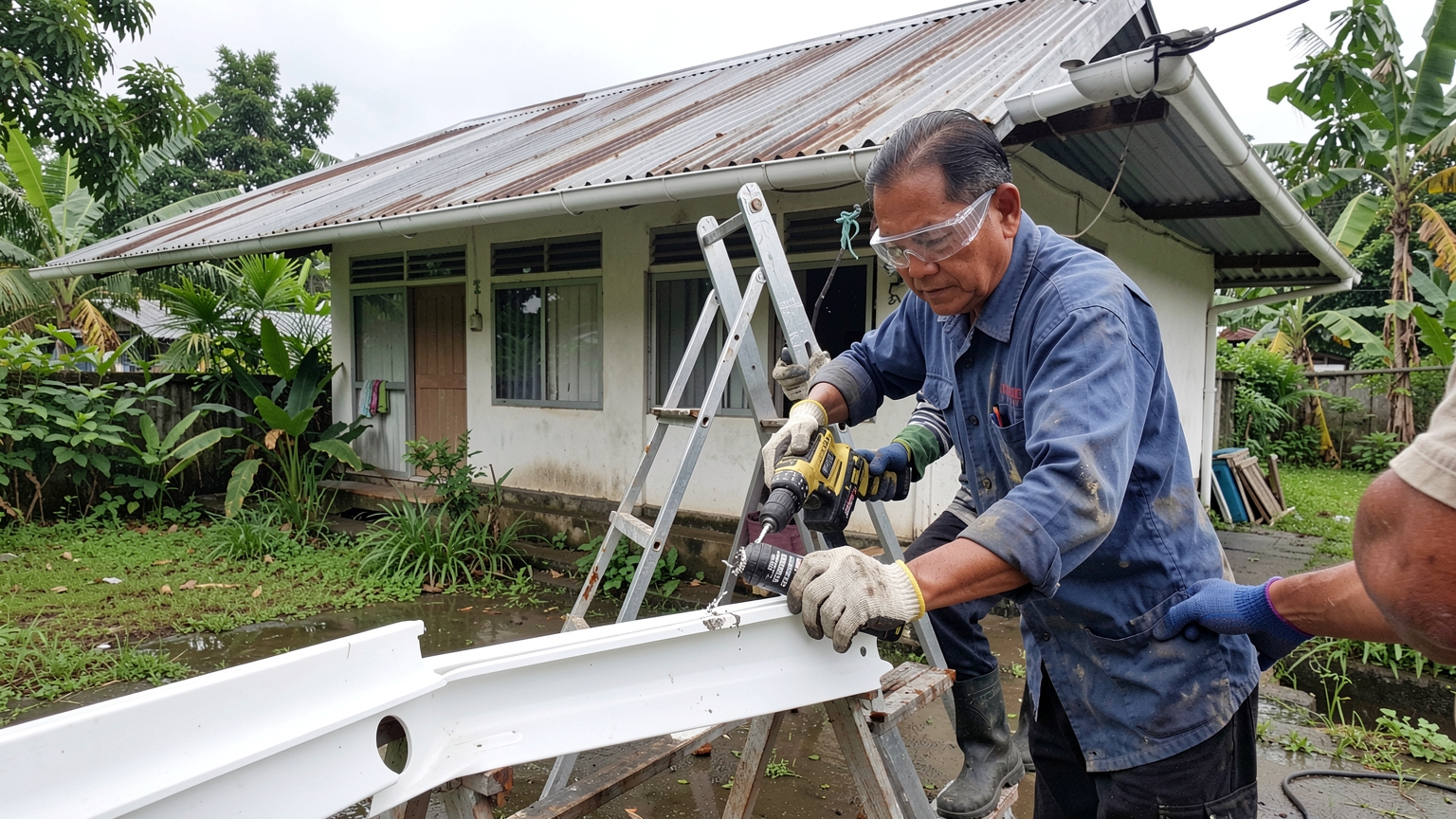
Seal the outlet, then fit the downpipe with an elbow at the top and wall clips every 1 to 1.5 metres. Use 75 to 90 mm pipe if the shop has it, as wider pipes block less easily.
Lead the water away
At the bottom, fit an elbow and a short pipe or splash block that carries water at least one to two metres from the wall. Send it to a drain, a soak pit or a rain tank with a safe overflow. Do not send it onto a neighbour's land or a path. Check local rules on where storm water may go.
Fix 3: Fix sagging brackets and the slope
A gutter needs a gentle, even fall toward each downpipe. A common guide is about 1 cm of drop for every 2 to 3 metres. One sagging bracket makes a low pocket. Water sits there, adds weight, and the sag gets worse.
Set a straight line
On a dry day, tie a string line along the fascia from the high end to the downpipe, with the right fall. Check each bracket against the line. Pour a bucket of water in at the high end and watch where it pools.
Replace or add brackets
Remove loose or bent brackets. Screw new ones into solid wood, not into the old holes, using rust-resistant screws. Space brackets about 60 to 90 cm apart, closer at corners and outlets. If the screws will not grip, the fascia may be rotten. Stop and have a carpenter replace it, because a rotten board can pull the whole gutter down.
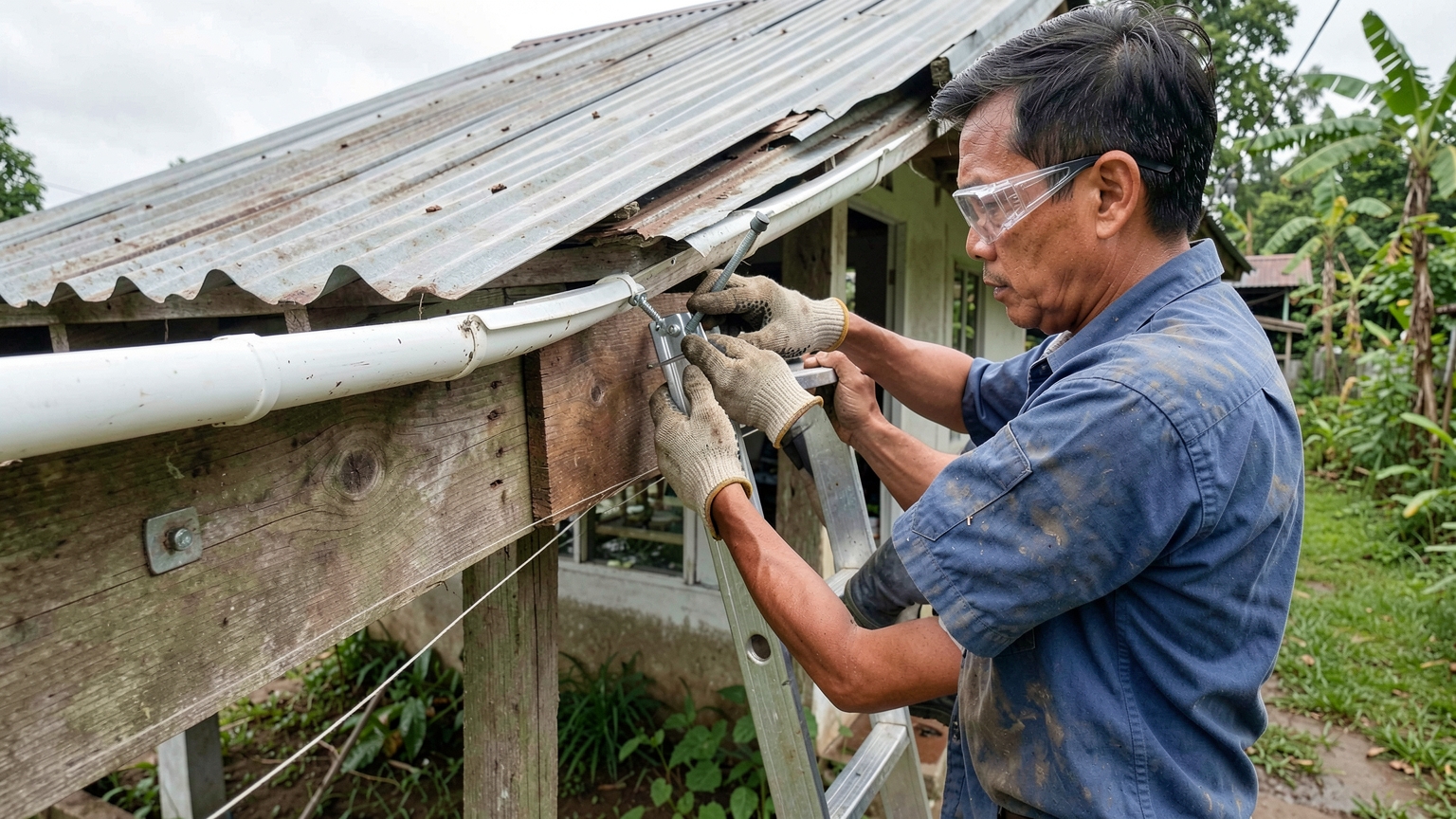
Clip the gutter back in and test with water again. It should run steadily to the downpipe with no pools.
Fix 4: Fit simple mesh leaf guards
Mango, bamboo, coconut and other trees drop leaves into gutters all year, and storms bring down even more. A simple mesh cover keeps most of them out.
Clean first
Wearing gloves, scoop out leaves and mud with a small trowel into a bucket. Flush the gutter and downpipes with a hose. If a downpipe stays blocked, push a garden hose or plumbing snake up from the bottom, never by standing on the gutter.
Cut and fit the mesh
Use aluminium or galvanised mesh, or strong plastic mesh, with holes of about 5 to 10 mm. Mosquito net is too fine and clogs with dust. A roll often costs roughly 5 to 20 US dollars, depending on size and place. Cut strips a little wider than the gutter on the ground, wearing gloves. Slide one edge under the roof sheet edge and bend the other over the front lip of the gutter. Hold it down with cable ties or small clips every 30 to 50 cm, so strong wind cannot lift it.
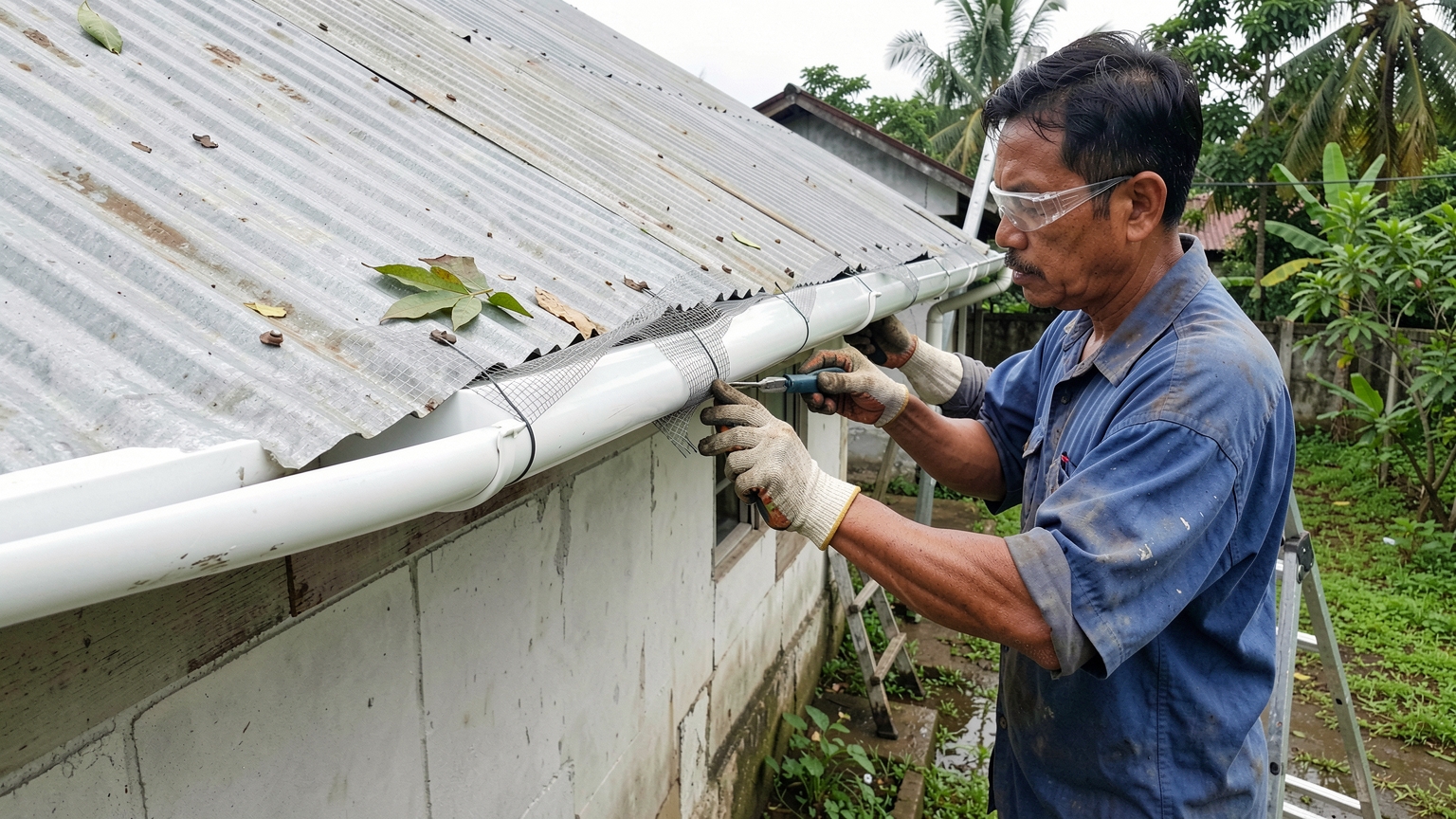
Fit a small wire ball or dome guard over each outlet as well. Mesh reduces cleaning but does not end it. Brush the top of the mesh after big storms, and check your gutters again during the next heavy rain to make sure every fix is working.