Pond Overflow Pipe: Stop Banks Washing Out in Heavy Rain
Heavy rain eroding your pond banks? Fit a simple overflow pipe that drains excess water safely and keeps your fish inside.
Published
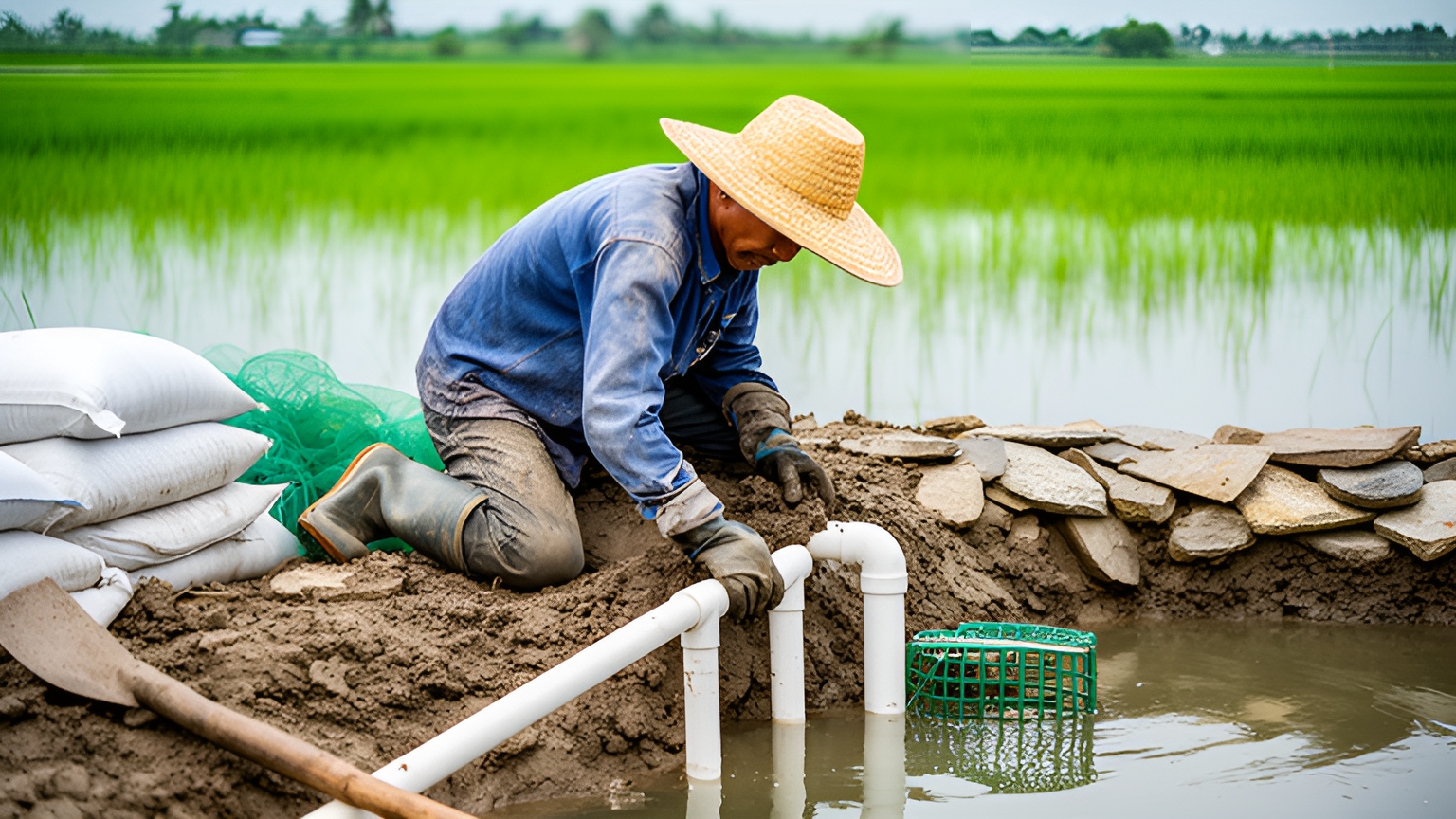
When heavy rain fills a pond faster than it can drain, water spills over the lowest point of the bank. In a few hours that small trickle can cut a deep channel, wash out the bank and carry your fish into the field or the canal. A simple pond overflow pipe, set at the right height, gives extra water a controlled way out instead. Add a stone or sandbag spillway as a backup and a net to keep fish in, and most small family ponds can get through a heavy storm with their banks and fish in place.
Why pond banks wash out
Most farm ponds in Southeast Asia are dug from earth, and the soil from the hole is piled up to make the banks. Earth banks hold water well, but they do not like water flowing over them. Moving water picks up loose soil. Once a small gap forms, the flow speeds up and the gap grows. This is how a bank can fail in one night.
Common causes:
- No planned exit for extra water, so the pond fills right to the top of the bank.
- Runoff from roofs, roads or higher fields draining straight into the pond.
- A low spot on the bank that nobody noticed.
- Bare banks with no grass to hold the soil.
- Crab, rat or eel holes that let water leak through the bank.
The fix is simple in idea: decide where the extra water goes, and make that path strong.
Before you start: safety and local checks
Conditions differ a lot across the region. Soil type, rainfall, flood levels, rules about draining water onto neighbours' land or into public canals, and permits for earthworks all vary by country and district. Talk to your neighbours about where the overflow water will go, and check with your village office or a local agricultural extension officer. For large ponds, banks higher than about 1.5 metres, or ponds that sit above houses or roads, ask an experienced local builder or engineer. A failing bank on a big pond can be dangerous.
Work safely:
- Work in a break between storms, in daylight. Never work during heavy rain or lightning.
- Never stand in fast-moving water or on a bank that is cracking, sinking or leaking muddy water. Move away and get help.
- Always have a second person nearby when working at the water's edge. Deep water and soft mud can trap a person.
- Wear work gloves, rubber boots or sturdy shoes with good grip, and a hat. Wear eye protection when cutting pipe or breaking stones.
- Lift sandbags and stones with bent knees, and share heavy loads.
If water is already pouring over the bank, the first job is to lower the water, not to build. Open any existing outlet, siphon or pump water out carefully, and place sandbags along the low spot. Build the pipe once the level is safe.
How to fit a pond overflow pipe
A pond overflow pipe runs through the top part of the bank. When the water rises to the pipe, it flows out through it instead of over the bank. PVC pipe is cheap, light and easy to find. For a small family pond of a few hundred square metres, a pipe 10 to 15 centimetres (4 to 6 inches) wide is a common choice. Bigger ponds, or ponds that collect water from a large area, need a bigger pipe or two pipes. A few metres of pipe plus fittings often cost roughly 10 to 40 US dollars, but prices vary widely by country.
Step 1: Choose the place and dig the trench
Pick a spot where the bank is firm and where the outlet can drain to a safe place, such as a ditch, a lower field or a canal, not towards a house or a path. Decide the highest water level you want. This is usually at least 30 centimetres below the top of the bank. Mark that level with stakes and a string line. Dig a narrow trench across the bank, just wider than the pipe, so that the bottom of the pipe will sit at that level.

Step 2: Lay the pipe and pack the soil
Lay the pipe in the trench with a gentle slope down towards the outside, so water drains freely. Let the outer end stick out past the outside face of the bank so water falls clear of the soil. Pack damp clay soil around the pipe in thin layers, about 10 centimetres at a time, and press each layer hard with a wooden tamper or your boots. Loose soil around a pipe is a weak point, because water can creep along the outside of the pipe and wash the bank out from inside. Some builders add a collar, such as a square of thick plastic sheet or a small concrete ring around the middle of the pipe, to block this leak path.

Step 3: Fit netting to keep fish in
Fish swim towards moving water, so an open pipe can empty a pond of fish in one night. Fit a PVC elbow or tee on the inlet end and build a cage around it from plastic-coated wire mesh or strong nylon net. Tie it firmly with wire and fix it to a stake so it cannot float away. The mesh should be smaller than your smallest fish. A cage has a bigger surface than a flat net tied over the pipe mouth, so leaves and rubbish block it less quickly. Some people turn the elbow down so it takes water from just below the surface, where there is less floating debris.

Step 4: Protect the outlet
Water leaving the pipe can dig a hole at the foot of the bank and slowly eat into it. Place flat stones, broken concrete or filled sandbags under the outlet to make a splash pad. Line the first few metres of the drain channel the same way so the water slows down before it reaches bare soil.
Add a stone or sandbag spillway as backup
In a very heavy storm, even a good pipe can be too small or get blocked. A spillway is a wide, low, protected notch in the bank that takes over when the pipe cannot cope. It keeps the overflow in one strong place instead of letting it find the weakest spot.
- Choose a spot away from the pipe, ideally where the bank sits on firm natural ground rather than loose fill.
- Cut a shallow, wide notch, about 1 to 2 metres wide. Its floor should be higher than the pipe but 10 to 15 centimetres lower than the rest of the bank.
- Lay old rice sacks or a woven plastic sheet in the notch and down the outer slope. This stops soil washing out from under the stones.
- Cover it with flat stones packed tightly together, or with sandbags laid like bricks with the joints staggered. Carry the lining all the way down the outer slope to the bottom.
- Stake a net fence across the inside of the spillway, with the same small mesh as your pipe screen, so fish cannot escape when water flows.

Sandbags last longer if filled with a mix of sand and a little cement, then wetted, but plain sand or soil works for a short time. Check them often, as sun and water break down the bags.
Check and maintain while the rains continue
A pipe and spillway only work if they stay clear. After each storm, when the rain has stopped and the banks are safe to walk on:
- Clear leaves, grass and plastic from the net cage and the spillway fence.
- Walk the full bank and look for cracks, sinking spots, new holes or wet patches on the outside face.
- Check that the outlet splash pad is still in place and no hole is forming under it.
- Fill crab and rat holes with packed clay.
- Dig a small ditch or low earth ridge to send runoff from roofs and roads around the pond, not into it.
- Plant grass on bare banks. Vetiver and local creeping grasses hold soil well in many places.
Stop and call an experienced builder or engineer if you see muddy water leaking from the outside of the bank, a bank that is slumping or cracking along its length, or water flowing around the outside of the pipe. These are signs of a bank that may fail.
A few hours of work with a pipe, some net and a pile of stones or sandbags can save a pond that took weeks to dig. Every site is different, so adjust the sizes to your pond and your rain, and ask local farmers what has worked on their land.