Rainwater Harvesting in Cambodia: Simple Home Setup Guide
Collect clean roof water all wet season with gutters, a first-flush diverter and a jar or tank you can buy at your local market.
Published
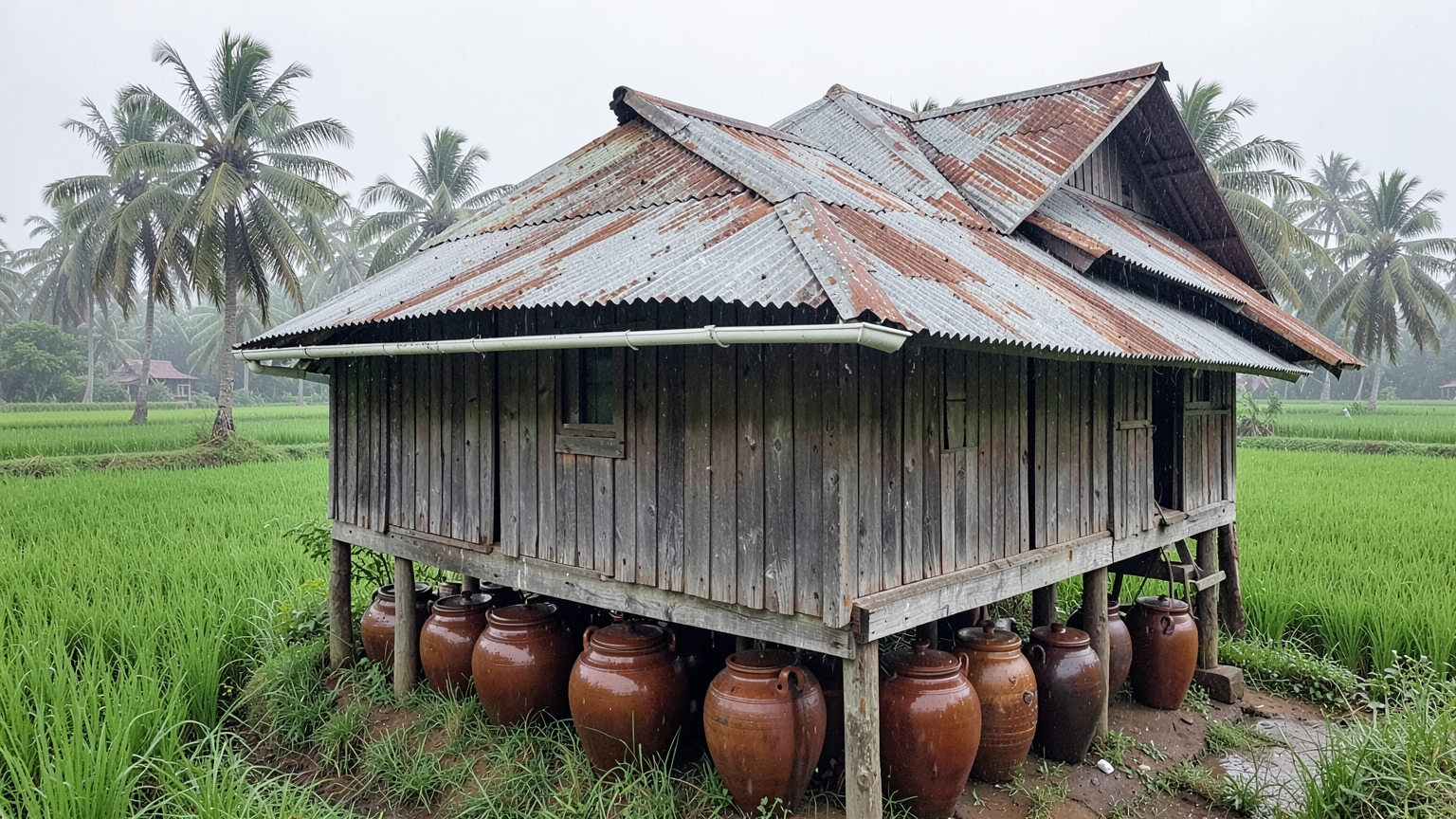
Most Cambodian homes already have the best water source they will ever own: the roof. With a simple setup, rainwater harvesting in Cambodia can give your family water for washing, cooking, the garden and animals for much of the year. You need only four parts: gutters, a downpipe, a first-flush diverter and a covered jar or tank. A family can build most of it in one or two weekends, with materials from the local market or hardware shop.
How rainwater harvesting Cambodia homes use actually works
Rain falls on the roof, runs into a gutter along the edge, and flows down a pipe. Before it reaches your storage, the first dirty water from the roof is sent away by the first-flush diverter. The cleaner water that follows goes into a large clay or cement jar (peang) or a plastic tank. A tap near the bottom lets you take water out.
It helps to know how much water your roof can catch. Here is a simple rule: 1 millimetre of rain on 1 square metre of roof gives about 1 litre of water.
- Measure the roof from above, not the sloped surface. A house 6 metres wide and 10 metres long has about 60 square metres.
- A heavy wet-season storm of 20 millimetres on that roof gives about 1,200 litres.
- Expect to lose some water to splashing, overflow and the first flush. Count on roughly 70 to 80 percent.
This shows why one jar fills very fast in the wet season. Many families start with one or two jars and add more storage later, so they can keep water for the start of the dry season.
Check your roof first
Zinc (corrugated metal) roofs and clay tile roofs are good for collecting water. Thatch and palm leaf roofs make water dirty and are better used for garden water only. Old grey fibre-cement sheets may contain asbestos. If you are not sure, do not cut or drill them, and ask someone with experience before using the water. Avoid roofs with peeling lead-based paint.
Gutters and downpipes
Gutters are the part people most often get wrong. If they are too small or slope the wrong way, monsoon rain will pour over the edge and your jar stays half empty.
- Use PVC gutters or folded zinc gutters. Both are sold in most provincial towns. PVC does not rust; zinc is cheaper in some places but needs more care.
- Choose a wide gutter. Cambodian storms are heavy, and a narrow gutter overflows quickly.
- Slope the gutter gently toward the downpipe, about 1 centimetre drop for every 2 to 3 metres. Too flat and water sits there; too steep and it rushes past.
- Fix strong brackets every 60 to 90 centimetres. Wet leaves and storm wind put a lot of weight on gutters.
- Put a simple mesh guard over the gutter or at the top of the downpipe if trees like mango, tamarind or coconut hang over your roof.
For the downpipe, PVC pipe is the easy choice. Keep bends to a minimum, because each bend can trap leaves.
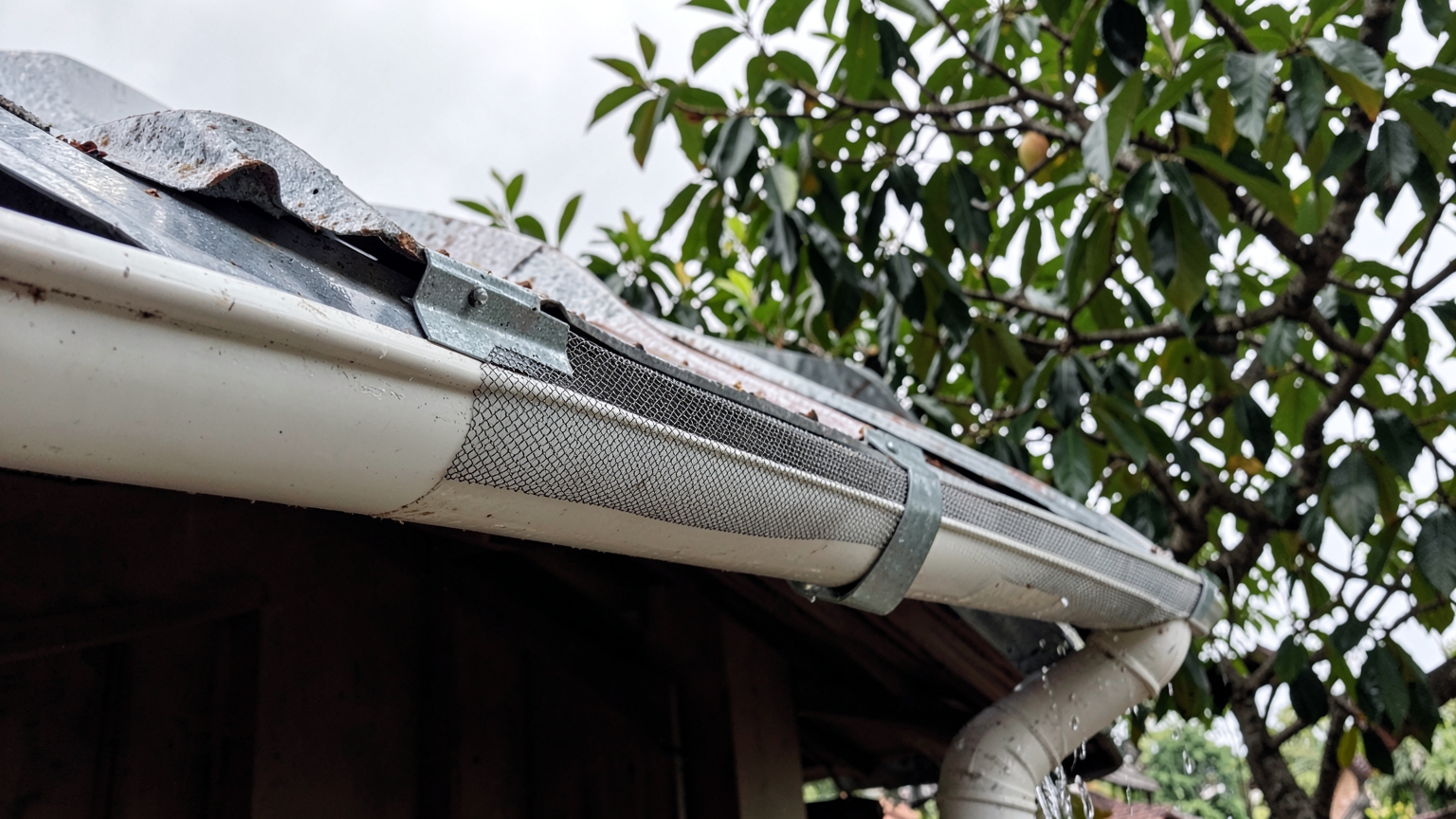
If you need a ladder on a high roof, work with a second person holding it. For a two-storey house or a roof in poor condition, it is wise to pay a local builder to fix the gutters.
The first-flush diverter: your most important part
After days without rain, a roof collects dust, bird droppings, dead insects and leaves. The first rain washes all of this off. A first-flush diverter catches that first dirty water so it does not go into your jar.
You can make a simple one yourself from PVC pipe:
- Fit a T-joint into the downpipe above your jar.
- From the T, run a vertical pipe downward. This is the flush chamber. Close the bottom with an end cap.
- Drill a very small hole in the end cap, or fit a small tap, so the chamber slowly empties after the rain.
- Some people put a light plastic ball inside the chamber. When the chamber fills, the ball floats up and seals it, and clean water then flows on to the jar.
How big should the chamber be? A common rule of thumb is about half a litre to one litre of flush water for every square metre of roof. Use the bigger number if your roof is near trees, a road or a rice-husk fire. For a 60 square metre roof, that means roughly 30 to 60 litres. You may need a long pipe or a wider pipe to hold that much.
After each rain, check that the chamber has emptied. Every few weeks, open the end cap and wash out the mud that collects inside.
Choosing a clay jar or plastic tank
Both work well. The right choice depends on your space, budget and how much water you want to keep.
Clay or cement jars (peang)
Large glazed clay jars from Kampong Chhnang and cement jars made in many villages are a Cambodian tradition. They keep water cool, last many years if not knocked, and are easy to clean. Common sizes hold from a few hundred litres up to about 2,000 litres. You can line up several jars and connect them with pipes, or move water by bucket.
Plastic tanks
Plastic tanks of 500 to 2,000 litres, or larger, are sold at hardware shops. They are light, come with a lid and a tap fitting, and are good when you want a lot of storage in one place. Choose a food-grade tank in a dark or opaque colour. Light passing through a clear tank makes green algae grow.
Setting up any container
- Place it on a firm, level base of bricks or concrete. A full 1,000 litre tank weighs about one tonne.
- In flood-prone areas, raise the base above the highest flood level you remember.
- Always cover it with a tight lid or fine mesh. Open water lets mosquitoes breed, including those that spread dengue.
- Fit an overflow pipe near the top that leads water away from the house foundations, into a garden bed or a drain.
- Put the tap a few centimetres above the bottom so you do not draw out the sediment.
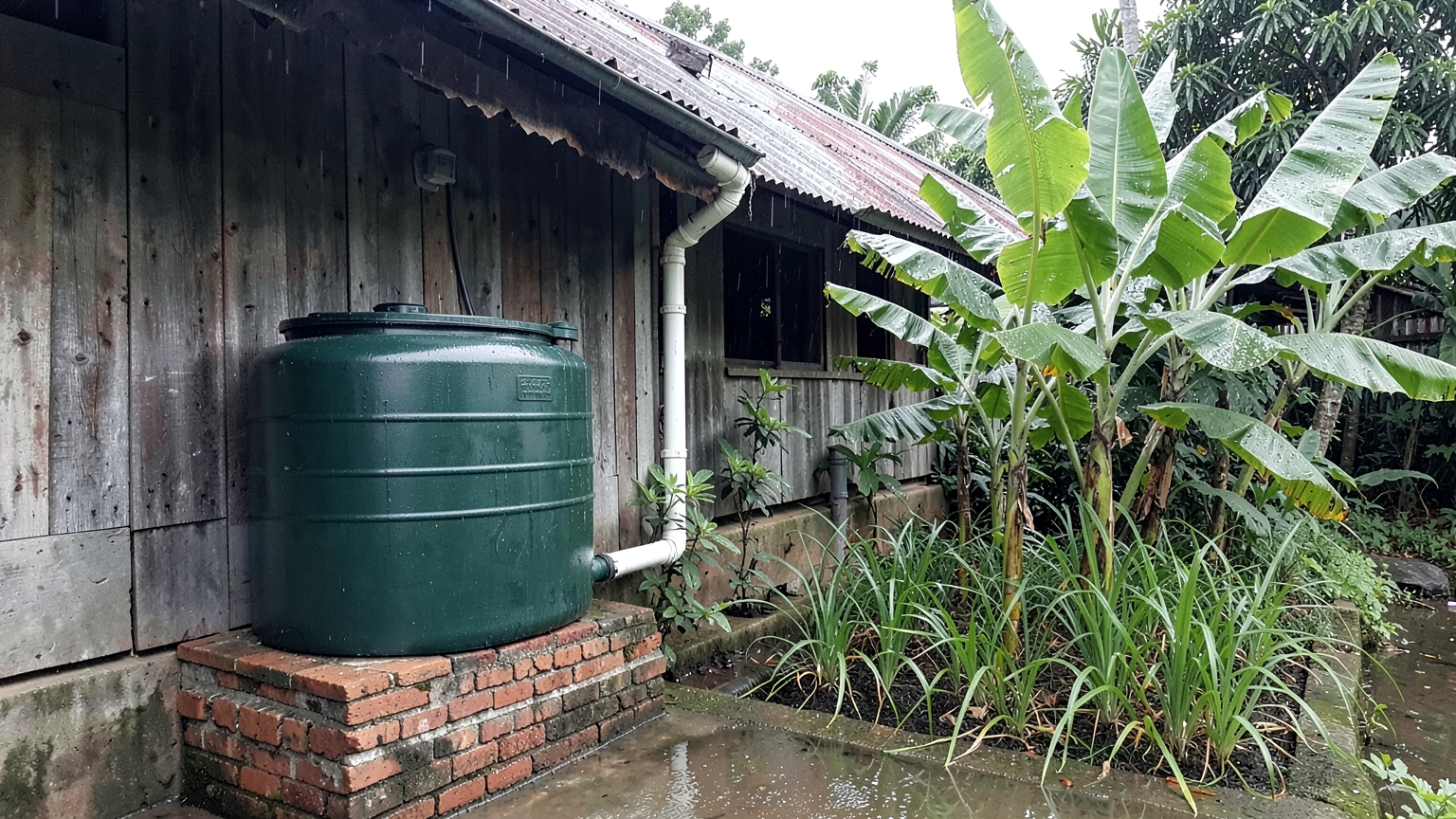
A tall water tower or a very large tank on a raised stand is structural work. Ask a builder to design the stand, because a collapse can hurt people.
Typical local costs
Prices change a lot between Phnom Penh, provincial towns and remote villages, and they change over time. Use these rough ranges only for planning, and always compare a few shops.
- PVC gutters and brackets: often a few dollars per metre, so a small house may need around 20 to 60 US dollars.
- PVC downpipe, joints and end caps for a diverter: often around 10 to 30 US dollars.
- A large clay or cement jar: often from about 10 to 40 US dollars, depending on size and quality, plus transport.
- A 1,000 litre plastic tank: often around 60 to 150 US dollars, depending on brand and thickness.
- Taps, mesh, lids and cement for a base: usually a further 10 to 30 US dollars.
A simple one-jar system can cost well under 100 US dollars if you do the work yourself. A larger system with a big tank and a raised base will cost more, especially if you hire help.
Keeping the water clean and safe
Roof water collected well is good for washing, bathing, cleaning and the garden. For drinking, treat it first. Boiling, a ceramic water filter or another proven filter used correctly are common choices in Cambodia. Do not assume rainwater is safe to drink just because it looks clear.
A short routine keeps the system working:
- Before the wet season starts, around April or May, clean the roof, gutters and diverter.
- Let the first one or two storms of the season flush away, even if your diverter is working.
- Clean jars and tanks at least once a year. Empty them, scrub the inside, and rinse well.
- Check lids and mesh often for holes.
- Cut back branches that hang over the roof.
Start small, watch how fast your jar fills in the first storms, and add more storage when you see how much water your roof can give. Over a few seasons, your roof can become a steady, low-cost part of your family's water supply.